The Gray Area in the Sharing Economy

To determine whether the sharing economy is a wolf in sheep’s clothing or not, the first step is to take a look at the sharing economy’s gray area. I have emphasized that the sharing economy is a baby who we need to take care of. It was born with arguments because it was born with its gray area. 

The first sharing-economy-related company is eBay, an online marketplace that facilitates consumer-to-consumer and business-to-consumer sales that launched in 1995. However, the term “sharing economy” suddenly became popular in the last decade. The success of Airbnb and Uber proves that the sharing economy works well. In my first blog post, I discussed a few reasons that make the sharing economy successful, but the most important one is the global recessions. The global recessions make people less willing to take money out of pockets and actively seeking cheaper alternatives. Where there’s a demand, there’s supply. Following Airbnb’s birth, more and more sharing economy companies enter the market after 2008. Then, these companies earn billions of dollars while selling their stories of how the sharing economy can reshape the world in a better way. 

Nevertheless, as the sharing economy developing, more issues are found. The overall issue is that the law doesn’t consider the existence of the sharing economy. The lack of legal, fiscal and labor regulation is urgent. While taking action to complete the law, arguments come along. Take Airbnb as an example, it is not welcomed in its oldest market, New York City. According to PYMNTS, “The city does not allow owners to rent out their entire home for less than 30 days if the owner is not present on the premises…to help people break the rules for short-term rentals.” Otherwise speaking, if you are an Airbnb host in New York City, you must rent your entire home out for more than a month, or your homes are being used for short-term rentals illegally. Since most of the hosts only rent part of their home out, about two-thirds of the hosts have broken the law. 

For this reason, New York City sued Guesty Inc., a startup that provides services for listings on Airbnb and other sites to escalate its war on short-term apartment rentals. The news updated on March 3, 2020, in Bloomberg says, “The city said Guesty Inc.’s business model is focused on helping people flout laws against short-term rentals.” That is to say, the city thinks Guesty Inc.’s business in NYC has damaged the housing market and neighborhood. Besides, a law passed last summer requires the home-sharing services to disclose monthly to the city (the NYC) detailed information about tens of thousands of listings, and the identities and addresses of their hosts according to the New York Times. In other words, Airbnb has to provide its information about hosts to the city government monthly, yet Airbnb claims that it disrupts the privacy of hosts. 

The war between Airbnb and New York City is still going on. We can see the gray area in the sharing economy from this complicated example. The law is not complete. It is reasonable to have the city government to take care of the local rental market for equality purposes. It is also right for the company to protect its users’ profit. Similarly, San Francisco required Airbnb hosts to register in the city government before starting to be a host. Another issue here is that the sharing economy does a negative impact on the traditional market. In this case, Airbnb damages the local housing market by taking housing resouces; and those major cities like NYC and San Francisco have a lack of housing. 

Remember that, study economy is to study scarcity. Of course, the sharing economy has improved the way to reallocate resources, but it also takes products/labor/capital out of the traditional market. It takes too long to have the market self regulate, so in my opinion, having laws to regulate the market is the most efficient way. New York City has done a good example of regulating the sharing economy by making laws. 

Then we need to know, what law to make and how to make law? In the law journal, “Regulating Sharing: The Sharing Economy as an Alternative Capitalist System“, the author Professor Rashmi Dyal-Chand underlines that, “…policymakers do not recognize the sharing economy as a different form of capitalism that it is. They view it as breaking the rules of market behavior, rather than creating a new set of rules.” In other words, the sharing economy is different from capitalism (the traditional market product) so the current laws don’t fit for them and the new laws should be made base on the sharing economy’s character. In her article, Dyal-Chand provides in detail some ways to improve the sharing economy. In my interpretation, the following things need to be considered first: perfect the law (tax, regulation, license), public the information and data, and self-regulation. And yet it will take a while to improve the sharing economy. As Dyal-Chand says, “Meanwhile, the core challenge of protecting customer safety remains largely unaddressed because participants in these markets continue to operate in a gray market of sorts.” (245) The gray area in the market needs to be taken off so that fewer people will be hurt. 

Whether the sharing economy does positive or negative effects on our society, its existence reflects part of the situation in the world. This is, we cannot wait to find a better way to solve the scarcity issue. Overall, we are facing issues in the sharing economy because there’s a gray area. The sharing economy is a wolf because it takes sheep’s life (the traditional market); but if we can domesticate this wolf (Eliminate gray areas), it will become our best friend in rising the world economy and solve the scarcity issue. 

The Sharing Economy: A Wolf in Sheep’s clothing?

The sharing economy is born with arguments, preconceptions, and fairy tales. Those who are neutral call that arguments and supporters of the sharing economy call it preconceptions. The opponents call the sharing economy a fairy tale. In my earlier blogs, I mentioned that the sharing economy is not a new business model but a social movement; and it can serve to solve some social issues if we utilize it properly. However, some professions disagree with the idea of the sharing economy while some think the sharing economy can be a good way to build up a green economy worldwide. 

So the issue is, is the sharing economy a wolf in sheep’s clothing or should the sharing economy be promoted? 

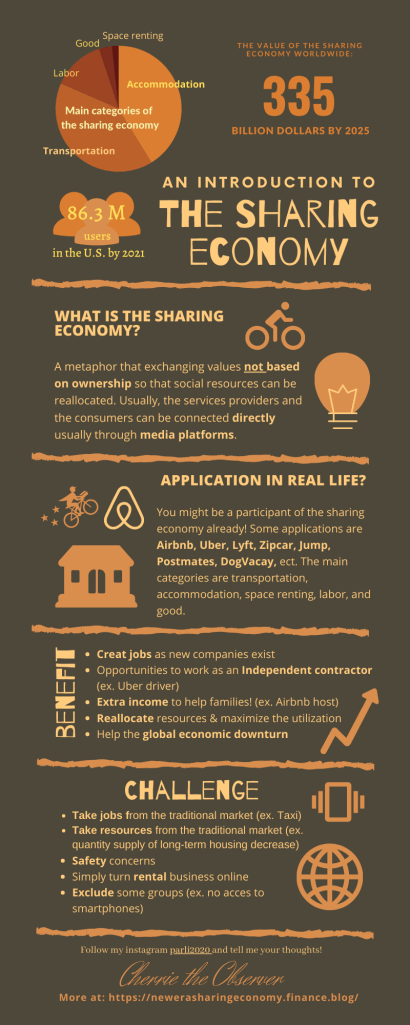
The size of the sharing economy worldwide is expected to be 335 billion U.S. dollars by 2025 from only 15 billion dollars in 2014 according to Statista. In the United States, 44.8 million adults were using the sharing economy services in 2016 and this number will increase to 86.5 million by the year 2021. Behind these huge profits, many sharing economy countries exist and cover every need in urban people’s life. As for now, there are 100 and more sharing economy companies. The main five categories are transportation, accommodation, space renting, good, and labor. Among that, transportation and accommodation are more popular. Two acknowledged leaders are Airbnb and Uber. Airbnb is an online marketplace arranging short-term lets and it is now the most successful example of the sharing economy; it was valued more than 31 billion dollars in 2017. Airbnb builds its “kingdom” worldwide without owning real estate listings in more than 192 countries. Besides, Uber is a ridesharing company that provides peer-to-peer driving services, food delivery, and a micromobility system with electric bikes and scooters. In most of the major cities in the world, we can frequently find Uber or its similar products which provide peer-to-peer driving services. 

We are not sure when did the sharing economy birth but it has been widely discussed in the last decade till now. In a famous book “What’s Yours Is Mine: Against the Sharing Economy“, the author Tom Slee talks about many reasons that the sharing economy is evil by analyzing some main sharing economy services. The three main issues he found were about employment, investment, and intention. 

In Chapter 5 of the book, Slee discusses the first company in personal and home services, TaskRabbit. TaskRabbit is designed as an online marketplace to connect neighbors to help out neighbors. For example, if you need to fix your lightbulb in an emergency, you can simply go to TaskRabbit and get your neighbor to help by paying a service fee. Meanwhile, your neighbor can get some extra money. However, the problem here is, for those who are willing to provide such a service are mostly unemployed people. They worth more but they are not guaranteed to get minimum wages even though working hard on heavy tasks. The initial intention of TaskRabbit is brilliant, to let neighbors help neighbors. However, as becoming a job, it seems unfair to have workers working hard while the company does not need to guarantee them minimum wages, sick hours and health insurance. Similarly, Edward t. Walker says so in his journal article “beyond the rhetoric of the ‘sharing economy’ ” in Contexts “… ‘be your own boss’ light, but it’s worth noting that contractors aren’t offered the health and social safety-net benefits of conventional workers.” Yet they are independent contractors; taking the whole market, the existence of these sharing economy companies took jobs out of the traditional market but did not create as much as jobs. 

 Also, as I mentioned in my second blog, Uber drivers are getting themselves from independent contractors to formal employers which makes the story of Uber different. The California Assembly Bill 5 (AB5) passed in fall 2019 required companies like Uber and Lyft to treat contract workers (drivers) as employees. It is great for full-time drivers since they can get their employee welfare. We don’t know yet what will this bill acts on to consumers and the whole market. Maybe the price will increase and maybe not. Unlike other sharing economy services, Uber and Lfyt set prices by running calculations which means drivers cannot adjust the price. Nonsuprisly, Uber is currently testing a new feature in California that allows some drivers (in 3 airports) to set their rates so that drivers can have more control as independent contractors (Uber still wants to keep as much as contractors they can) according to a news report in NPR. For other sharing economy companies, both the service providers and consumers have the ability to be price takers (which means their actions can affect the market price). Thus, Tom Slee analyzed that many sharing economy companies look forward to Adam Smith’s idea of the “invisible hand” of the free market and use that as an excuse to ignore some overpriced situations and the minimum wage issue.  

Furthermore, Slee indicates that “The main impulse that drove the writing of this book was a sense of betrayal: that what started as an appeal to community…and sharing, has become the playground of billionaires, Wall Street, and venture capitalists extending their free market values ever further into our personal lives.” (Slee, 161) Otherwise speaking, Slee againsts the sharing economy as an incarnation of capitalism, a tool that been played by rich. He mentioned that the sharing economy brings tones of jobs to software engineers and computer engineers but not ordinary. Relative to this issue, another issue is about the story of the sharing economy. Look through all the stories of the sharing economy, one connection found is about sharing makes the world better. A sharing economy maginze, Shareable, believes that “The sharing transformation shows that it’s possible to govern ourselves, build a green economy that serves everyone, and create meaningful lives together.” In another world, they believe that sharing economy means to have consumers in hand of our economy and make everyone better off. The story of the sharing economy is perfect as a fairy tale in the opponents’ interpretation. There are many biases, however, in the sharing economy system. 

The sharing economy, nowadays, is presenting in many ways in our daily life. It changes the way we take a ride, get some food, rent a place, walk a dog and even more. The reason that we care whether the sharing economy is making us better off or not is not just because we are the participants, but this topic affects the whole world. It doesn’t matter if we ever took Uber or not, our life is relative to Uber already. To care about the world economy is to care about your own life.

The issues named above are the tip of the iceberg. As the sharing economy extended and developed, more and more disadvantages are shown. In this issue series, we separated some main issues; but is the sharing economy not worth? Is it a wolf in sheep’s clothing? The next issue series will continue to present more on this topic. 


Reference: 

Barriers of the Sharing Economy in Developing Countries

Not many people have noticed that the sharing economy is changing the world. The value of the sharing economy worldwide is predicted to increase to some 335 billion U.S. dollars by 2025 from only 15 billion dollars in 2014 according to Statista. That is a crazy increase that hopefully can help the global economic downturn. In my previous three posts, I mainly talked about the sharing economy in the U.S. (which represent developed countries). Now, Let’s deep in discussing the sharing economy in developing countries.


Remember that the sharing economy is commonly considered as a metaphor that exchanging values not based on ownership so that social resources can be reallocated and maximize the utilization. One of the features of the sharing economy can be interpreted into an economic model in which the services providers and the consumers can be connected directly usually through media platforms. Some examples are Airbnb, Uber, Zipcar, and JustPark. Three highlights of this metaphor are “not based on ownership”, “connect suppliers and consumers directly”, and media platforms.


These three requirements can be satisfied easily in developed/high-income countries but not in low-income developing countries. Thus, these requirements become barriers to the development of the sharing economy. Besides, in the article “The Sharing Economy In Developing Countries” published by the Institute for Sustainable Futures (ISF), it says “The key barriers to the sharing economy in developing countries are likely to include: a lack of trust, social norms, technology, electronic payment systems, a lack of assets and skills and a lack of regulations.” That is to say, it is not possible to have a modern sharing economy in low-income countries in the short term with these barriers. The social norms appear to be the most significant barrier from previous researches. Ownership is be viewed as very important in tradition, so it is reasonable that people reject to share something with strangers. In many cultures, a big goal of working is to own something whether a house or a car so people may find it uncomfortable to share it with others. Also, conflict of interest might occur and resist the entry of the sharing economy to the market. For example, Tuk Tuk (auto-rickshaws) lost a part of its consumers since PassApp (a Cambodian version of Uber) exists.

These different perceptions of the sharing economy can be changed over time but some software foundations needed to be available to adopt the sharing economy. Technology enables the media platforms which connect suppliers and consumers directly and the media platform requires electronic payment systems. However, in many low-income countries, owning a mobile phone is luxurious, then how can the sharing economy network be built? From the Pew Research Center, Africans who own a mobile phone are mainly upper-class young males. For example, in Kenya, there are approximately 40% to 60% of mobile phone users (not necessarily smartphones), but 58% of the people said they shared phones with others. Even though there is an increase in mobile phone users in developing countries, for the sharing economy to take place, the widespread use of smartphones is the first requirement.


The lack of regulation is the biggest barrier in the sharing economy. The law and regulation are not comprehensive even in developed countries. Some challenges are regulatory fairness, monopoly issue, protection of labor’s rights, protection of users’ information, and tax issues. In other words, regulations are needed to protect the right of suppliers, consumers, laborers, and taxpayers. One example involving the trust issue is the protection of users’ information. The authors Yide Ma and Haoran Zhang state so in their article “Development of the Sharing Economy in China: Challenges and Lesson“, “If there are no sound protection measures, once the information is leaked, the user’s personal privacy will be damaged… also involve national security risks if massive amounts of data and information were leaked.” Otherwise speaking, for the trust of the sharing economy, privacy is a core.

We have said that the new era is coming embracing the sharing economy. As for now, developed countries present well, and the sharing economy contributes a lot to their GDP (Gross domestic product). For developing countries, there are barriers needed to be removed. However, why do we desire the sharing economy in developing countries? A recent project lead by the International Development Research Centre (Canada) illustrates that “Advocates of the sharing economy … have a significant impact on labour markets, environmental sustainability and consumption habits… Largely urbanized regions in developing countries with substantial challenges related to transport, climate change and housing are seen as frontier markets for businesses that engage in the sharing economy.” The sharing economy is expected to be a solution to issues in developing countries such as urbanization, a large amount of population, and an economic downturn. If the sharing economy can be achieved, the issues mentioned above can be solved since the social resources will be reallocated. 

Some developing countries have made significant progress in the sharing economy. According to Xinhua News, in China, the sharing economy market size stood at 7.36 trillion RMB (about 1.054 trillion USD). The Chinese government supports the sharing economy a lot these years too. The benefits of the sharing economy are obvious, but there is still a long way to make the system perfect. 

After all, the sharing economy can be a way to encourage economic growth and sustainability in developing countries; but before that, we should have necessities such as regulation and software infrastructure. I believe that both developing countries and developed countries will embrace the sharing economy in the recent future. 

New Era for the Sharing Economy?

We all value the importance of technology. Our generation is experiencing a change in internet improvement, from the birth of the first computer to the existence of AI. They call it “the Fourth Industrial Revolution”. Technology allows the sharing economy’s growth since many tasks can be completed online, but is the new era for the sharing economy coming? 

 The metaphor, sharing economy, can be interpreted into a short term leasing that happens between the provider and the consumer only. It is often discussed with the gig economy (which involves the independent workers) and peer-to-peer economy (connect seller and consumer only). The main idea of the sharing economy is “share”, to share your idle items (car, room, parking, etc.), to share your leisure time (work as a contractor), or to share everything you can think about.

 It seems like everything can be shared. There are more than 100 active sharing economy companies whose services cover every need in urban daily life. The main categories are transportation (ride-sharing/vehicle renting/bike sharing), accommodation, rent space (share office/parking), labor (childcare/petcare), and good (cloth, jewelry, food). However, as we can tell, not every sharing economy company success. The top two most famous representatives are Airbnb and Uber so we notice that transportation and accommodation play a more important role than other sharing economy categories. These two products shorten the time for users to match with short-term housing and a ride. According to Statista, “In 2017, the number of adults using Airbnb in the United States amounted to 33.9 million…to reach 45.6 million by 2022.” For the number of sharing economy users in the US, it grows from 44.8 million to 81.2 million this year and will reach 86.5 million in 2021. In other words, there are more and more sharing economy participants. It sounds like a good deal that can invest and create a green community-based economy. 

There are many sharing economy groups/organizations. On February 5 to 6, the first sharing economy global summit was held in London where gathers the sharing economy industry groups and their members all over the world. The event organizer, Marketplace Risk, aims to get information for the sharing economy and marketplace startup ecosystem. They believe in the advantages that the sharing economy brings. The event sponsors are mostly fans of the sharing economy including two famous organizations call Shareable and SEUK (sharing economy UK). One interesting fact is that Marketplace Risk’s headquarters is located in San Francisco while other sharing economy companies such as Uber, Lyft, Airbnb, Postmates, Doordash, TaskRabbit, and Lending Club have their headquarters in San Francisco. It is not hard to guess that a big city like San Francisco deserves the benefits of the sharing economy. 

 What are the strengths of the sharing economy? On my first blog, I mentioned that four big reasons for the rise of the sharing economy are technology allowance, environmental concerns, global recessions, and community re-connection. Now I would like to talk about the third reason global recessions. After the economic bombing, most countries are experiencing an economic downturn, thus people feel like they have to save money. The sharing economy allows consumers to find a cheaper alternative in a similar quality, and allow people to gain extra income by working as a contractor or rent out some idles things. The resource reallocation can make most people better off. As Shareable believes, “The sharing transformation shows that it’s possible to govern ourselves, build a green economy that serves everyone, and create meaningful lives together…we can solve the world’s biggest challenges — like poverty and global warming…” The sharing economy fans believe that by sharing, we can have a hand on the economy and make sure we all gain from the trades. 

 However, the opponents think the sharing economy is a lie. Taxi drivers hold a protest against ride-hailing and car-sharing services in major cities because their career is at risk of being replaced. A license for Taxi driving is needed but a ride-hailing driver only needs a regular license which means Taxi is safer in general. Other than damages to the traditional economy by taking job opportunities the sharing economy also damages the market by taking out long-term housing since those housing turn to Airbnb. It leads to the rise in rents in major cities even though the supply of short term housing increases. The safety concerns reduce the trust of the sharing economy since it is so easy to participate in the system. Opponents also claim that those “sharing economy companies” are simply turning short term leasing completed through online platforms; they do reallocate the resources. For example, Uber drivers initially are for whom they own a car and willing to give a ride to somebody in their free time, but now many people turn to become full-time Uber drivers. Items sharing should be a way people gain from renting their items out, but most item sharing becomes an online luxury rental. 

 Everyone, however, wants to get a slide from the sharing economy pie. How can we lighten the sharing economy? Some suggestions are to perfect the law (tax, regulation, license), public the information and data, and self-regulation. The authors Arvind Malhotra and Marshall Van Alstyne from the Viewpoints suggest, “To a great extent, the viability of shared services hinges on the quality of review systems because people rely on them to decide whether and what to purchase.” I agree with this idea because consumers have no choice but checking the reviews so if the reviews are fake, the trust is gone. This applies to all sharing economy products. 

 The sharing economy is still a baby and it needs to be improved. If all the suggestions above are taken, the era of the sharing economy will come in the recent future.

Uber and its Relation between the Sharing Economy

As we continue to talk about the sharing economy, there is no way to ignore one stand out product. That is Uber. Uber, a ridesharing company that provides peer-to-peer driving services, food delivery (UberEat), and a micromobility system with electric bikes and scooters. Uber is not a “100% sharing economy” product, but it has a big difference from traditional driving services like Taxi. Then we are curious about the relationship between Uber and the sharing economy. 

The sharing economy can be interpreted in many different ways but one of its features is the peer-to-peer economy which means to connect sellers and buyers directly through the internet without hiring employees or owning realistic products. Comparing Uber to Airbnb, there are many similarities as they are both “mix blood” (part of the sharing economy). Uber does not own the cars that serve its passengers and its team is also hidden behind the screen to connect passengers and drivers. Uber takes a cut of the fares from each ride just like Airbnb draws from each check-in. Usually, Uber takes 25% from fare and its competitor Lyft takes 20% from fare. Unlike Airbnb hosts, Uber drivers cannot set a fare, and they are assigned routes to get passengers to their destinations. However, Uber drivers can pick their schedule to work which means they can work as many hours as they wish anytime in a day. Due to the fixable working hours, many car owners start joining Uber/UberEat and treat it as a part-time job. My uncle is one of the part-time Uber drivers, and he said the initial purpose was to earn more money to support his family with two kids. Some people become Uber drivers to spend their leisure time. One Uber driver who owns a BMW told me that he enjoys driving at night because it is fun. 

Uber changes the way to take a ride and lower the price of delivery. Another factor of the sharing economy that makes Uber successful is an environmental concern. The fewer cars the fewer pollution. In big cities, there is more demand to take a ride since people want to avoid the massive public transit or do not want to deal with the parking issue. 

It seems like Uber drivers are not employees because of the character of Uber. However, Uber drivers fight for their rights for a long time and they won. According to the New York Times, “California legislators approved a landmark bill on Tuesday that requires companies like Uber and Lyft to treat contract workers as employees, a move that could reshape the gig economy…” In other words, the California Assembly Bill 5 (AB5) (or the “gig-worker rule”) redefines Uber drivers’ character so that they can enjoy benefits and have basic protection as regular employees such as minimum wages and unemployment insurance. 

At the same time, Uber still tries to keep as many independent contractors as possible. A state law that takes effect this year gives Uber drivers the ability to fix their fares. Uber is testing a new feature in California that allows some drivers (in 3 airports) to set their rates so that drivers can have more control as independent contractors. According to a news report in NPR, “It’s part of an effort to give drivers more control — and bolster the argument that they’re truly contractors rather than employees.” As we can see, most Uber drivers will still be independent contractors since there are more fixability and Uber is not willing to take all Uber drivers to employees.

Imagine that if Airbnb hosts become employees, the story will be different. Some characters of the sharing economy are to provide services without hiring employees and allows people to use their leisure time to provide the service. The Uber driver now become a career formally in California. Thus, Uber lost more features in the sharing economy. 

Back to our question in the beginning, is Uber still part of the sharing economy? The answer is yes. Even though Uber hires employees, they are still participating peer to peer economy since Uber still connects the drivers and consumers directly. Uber’s existence changes our lives. Uber creates a new way to take a ride. It inspires other similar services like DoorDash, Postmates, Lyft, Didi, and so on. It changes the way we take a ride. It replaces Taxi in major cities and creates many job opportunities thus bring up the national economy. However, if we are not a consumer of the sharing economy, why do we care about Uber, the gig economy and the sharing economy? No matter what, they are a movement of society, and we shall know more about the world we are in. I cannot predict the future of Uber after those bills pass, but what I am sure is companies like Uber will continue to serve us in a world that deserves the sharing economy. 

Sharing Economy— Airbnb and its Kingdom

Airbnb, an online marketplace arranging short-term lets, is commonly discussed as an excellent example of the “sharing economy”. It was valued more than $31 billion in 2017. Before we talk about Airbnb, we must discuss the following questions: what is sharing economy, why does the sharing economy exist, and how does/will it change our life? 

The sharing economy is poorly defined as a phenomenon. In my interpretation, sharing economy is a way to exchange value out of idle items without hiring employees. In the article “Sharing Economy“, the author Thomas Puschmann says, “the ‘Sharing Economy’ is built on using and sharing of products and services among others. The principle per se is not new…” In other words, he agrees that sharing economy is not a new concept but a second way to trade that is not based on ownership. Similarly, Airbnb defines itself as a house-sharing community, but in fact, it is also part of the traditional economy of short-term letting. Airbnb makes short-term letting happens online and connects hosts and guests which means it plays the role of the third party in this business. Airbnb doesn’t own any of the real estate listings and all its employees are hidden behind the platform. 

In the past decade, the term “sharing economy” became more and more popular. According to the article “New Forms of Economies: Sharing Economy, Collaborative Consumption, Peer-to-Peer Economy“, sharing economy develops fast for the following reasons: technology allowance, environmental concerns, global recessions(especially after 2018), and community re-connection. The improvement of technology allows Airbnb to better serve its community online. If there’s no technology supported, Airbnb will have a hard time to build up the market online. Airbnb focuses on major cities (such as New York, London, Hong Kong, etc) that need tourism but rents are generally high. Due to the global recession, the Middle class who own houses would like to get extra income, and tourists are willing to find a cheaper place to live. Besides, hosts can make their own decisions, for instance, select the date to rent out, fitter guests, arrange prices, and set rules. This freedom lets more house owners join the Airbnb community, and they can have a chance to meet with people around the world too. Many guests consider Airbnb as an alternative and a fun place to explore. As for me, I have a wonderful experience living with two cats during my trip through Airbnb. Comparing to a hotel, Airbnb houses will always bring me joy. We are expected to have standard things in a regular hotel room, but we can see new and fun things in Airbnb. As a cat person who never owns a cat, I enjoyed the days spending with two cats together. That will never happen if I chose a standard hotel.

There is a dark side of Airbnb unfortunately. In April 2019, there was a camera scandal in which a hidden camera was found in an Airbnb in Irland. Besides, hosts are concern about their properties’ safety and cases are showing that discrimination happens when hosts select guests. Shortly, Airbnb came out with regulations to solve them. Brian Chesky, the CEO/co-founder of Airbnb, says “[discrimination] is the greatest challenge we face as a company.” We can see that Airbnb puts efforts to solve this issue. However, Airbnb has removed some properties from the long-term rental market, thus, accelerates the shortage of housing. Airbnb was founded in San Francisco, where its rent was declared to be the highest in the world; but now it negatively affects the market while creating more short-term rental opportunities. 

The problems that Airbnb facing also challenge other post-sharing-economy platforms such as the safety issue, discrimination, effecting the traditional market, and so on. Airbnb succeeds as a post-sharing-economy product (not a 100% sharing economy product). It has extended its business kingdom globally and does well so far. It seems not hard to predict its future. Professions think that the sharing economy is “a social movement more than a business model” (Slee 2015). In other words, the existence of sharing economy is the trend of the world. As the urban population growing fast, sharing economy seems like a good way for us to save and distribute the limited resources. The way that people live right now also shows that they care less about the ownership comparing to the last generation. Even though there’s no real sharing economy product now, it will exist in the future. Thus, Airbnb will keep extending its kingdom until “the real sharing economy” substitution exists.

Now we turn to another question: why do we care about Airbnb and the sharing economy? It does not matter if everyone has participated in the sharing economy. It already changed the world around us. Now, maybe the sharing economy is not mature enough, it can be developed. Not everyone owns a car, so Uber makes urban life more convenient. Not everyone is satisfied with their income, so Airbnb helps them to rent a part of/one of their houses out to make some extra money. Taking the economy as a whole, it increases our total revenue. Sharing economy makes us better off. 

Design a site like this with WordPress.com
Get started